

When Lawmakers Leave Office
In partnership with the Center for Tech and Civic Life, this white paper explores early departures in state legislatures across the United States.
Overview
This project is a collaborative effort between the Center for Tech and Civic Life (CTCL) and the Institute for Responsive Government (IRG). CTCL works to ensure that all eligible voters, regardless of zipcode, can participate in the democratic process. IRG aims to ensure that governments are more responsive and accountable to their constituents.
Elected officials leaving office before the end of their term has significant impacts on civic life. State legislators pass laws, determine state budgets, and set taxes. When these offices sit empty, the interests of voters go unrepresented. Across the country, state legislators face increasingly insurmountable challenges that force many to reconsider their future in public office. As America approaches 250 years since the signing of the Declaration of Independence, the status of the fifty state legislatures is in flux as elected officials struggle to cope with rising consumer costs, heightened levels of political violence, and caregiving demands. But these struggles don’t just impact state legislators; public servants throughout all levels of government feel the effects. Local election officials, who run our elections and ensure voters have the opportunity to exercise their civic rights, similarly report threats against themselves or their staff.
These challenges acutely affect lawmakers who balance caring for their families and an increasingly hostile work environment. According to a study of bipartisan lawmakers commissioned by Future Caucus, roughly 80% of respondents report receiving salaries less than the cost of living in their state. Moreover, officials feel increasingly anxious about their personal safety and that of their families, with threats of violence acting as a “serious deterrent to both candidate recruitment and retention.” The response from state institutions to address the concerns of their members has been slow and lackluster, forcing some legislators to internalize threats as “part of the job.”
Through an analysis of state legislative vacancies occurring between 2020 and 2025, this project aims to identify trends of lawmakers who leave office before completing their elected term. This study examines how often early departures occurred, who those lawmakers were, and the reasons why they left early. With this information, CTCL and IRG seek to improve the experiences of state legislators so that they can better serve their constituents by highlighting state policies and relevant resources that support lawmakers while in office.
Scope & Methods
The foundation of the dataset of state legislative vacancies used in this study comes from CTCL’s Governance Project dataset. Since 2015, CTCL has updated the Governance Project dataset weekly to account for unexpected changes in officeholders, for reasons such as death or resignation. From this readily available data, we established a baseline understanding of the rate of and reasons behind unplanned, early departures in state legislatures between January 1, 2020 and June 30, 2025. For the purposes of this project, we define early departures as vacancies that occurred over the course of an office’s term, but prior to the official term end date determined by statute.
Prior to analysis, CTCL contacted state legislative clerks, librarians, and archivists to verify that all vacancies within the project’s scope were included. The expanded dataset underwent an additional quality assurance check to ensure its accuracy.
CTCL overlaid additional data attributes onto the state legislative vacancy dataset in order to identify any patterns among state legislators or impacted jurisdictions. These additional data attributes include demographic data of state legislators (age, race, and gender) and the structures surrounding state legislatures, such as required time commitment, whether virtual voting is permitted, pay, and regulations on outside employment.
For an overview of data attributes for this project, please refer to Appendix 1 in the downloadable report.
Summary of Key Insights
Where are state legislators leaving office?
- Between 2020-2025, vacancies in state legislatures occurred across all 50 states.
- Between 2020 and 2025, Arizona and Oregon had the highest rates of early departures for state legislative offices, with 33.3% and 30.0% of state legislators leaving office before the end of their term, respectively.
- Conversely, Arkansas and Rhode Island had the lowest rates of state legislators leaving office before the end of their term at 3.0% and 3.5%, respectively.
Who is leaving office early?
- Legislators across genders left office at rates similar to their proportional representation.
- Men accounted for 66-71% of officeholders and accounted for 71% of early departures.
- Women accounted for 29-34% of officeholders and accounted for 29% of early departures.
- White legislators departed early at a slightly lower rate than their proportional representation and Nonwhite legislators departed early at a rate higher than their proportional representation.
- White legislators in 21 states left office more often than the state’s overall vacancy rate.
- Nonwhite legislators in 27 states left office more often than the state’s overall vacancy rate.
- The age groups with the highest rates of early departure from office were 60-69 (23.6%), 50-59 (23.6%), and 40-49 (21.1%).
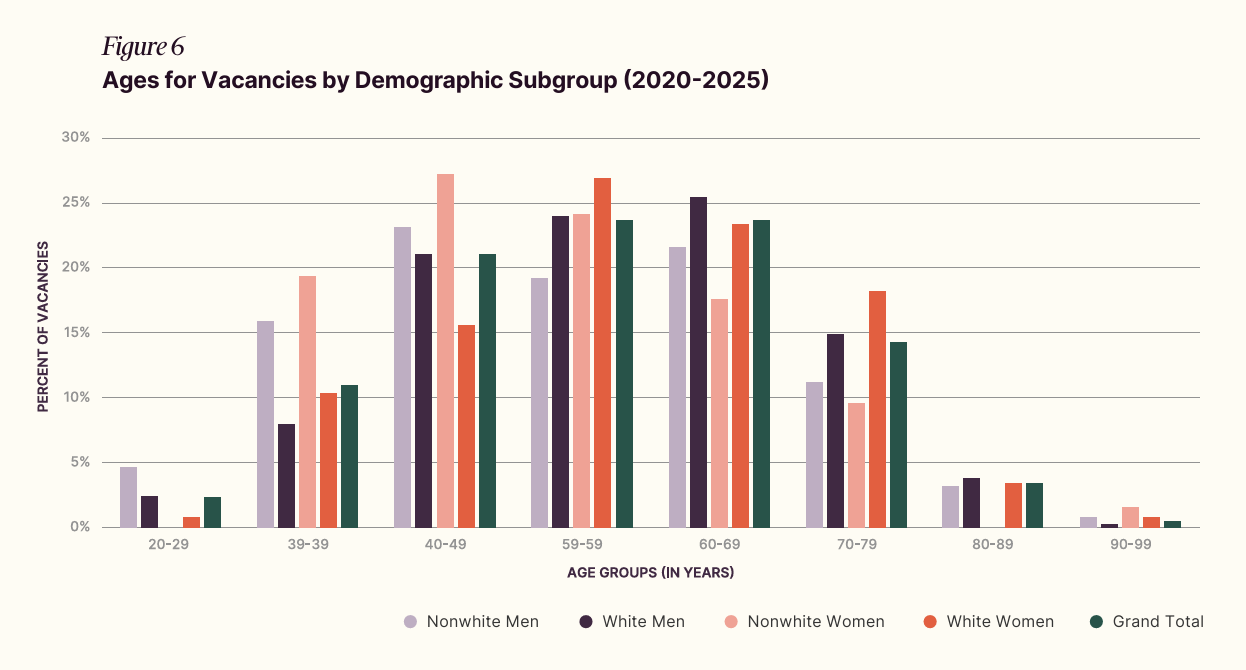
- Early departures for White men were highest near the average retirement age in the US of 62; whereas vacancies for White women, Nonwhite men, and Nonwhite women were highest earlier than retirement age.
Why are they leaving office early?
- Apart from death (12.3% of vacancies), state legislators most commonly left office early for a non-elected government position (15.4% of vacancies) or left public service entirely for private sector or non-profit jobs (9.9% of vacancies).
- Caretaking or family (5.0% of vacancies) and safety concerns (0.3% of vacancies) were among the publicly cited reasons for legislators who left office early.
- Reasons for early departure were generally consistent among state legislators across age, race, and gender demographics; however, Nonwhite women most commonly resigned for appointments to higher level elected offices. Additionally, Nonwhite women were the only demographic subgroup in which death was not among the top three reasons for early departure.
How are these vacancies filled?
- Offices filled through appointments were filled in an average of 29.2 days.
- Offices filled by interim appointment, followed by a special election were filled in an average of 23.7 days. Offices filled by a special election (with no interim appointment) were filled in an average of 123.9 days.
- When a seat was left empty until the next regularly scheduled election, the median number of days it stayed vacant was 173.0. These seats stayed vacant for an average of 181.4 days; however, four outlier offices that appear to have been vacant for 2-3 years skew the average to 205.4 days.
Where are State Legislators Leaving Office?
Between 2020-2025, vacancies in state legislatures occurred across all 50 states. Figure 1 shows that State Representatives made up the vast majority of vacating officeholders at 71.5%, with State Senators making up just 28.9% of vacancies in the dataset. This generally aligns with seat breakdown within bicameral legislatures in the United States, where State Houses are typically much larger than the corresponding State Senates.
Interestingly, legislative vacancies in Rhode Island were only from the State Senate. Similarly, legislative vacancies from Nebraska were only from the State Senate; however, that aligns with Nebraska’s unicameral legislature. In contrast, legislative vacancies in Alaska and New Hampshire were only from the State House.

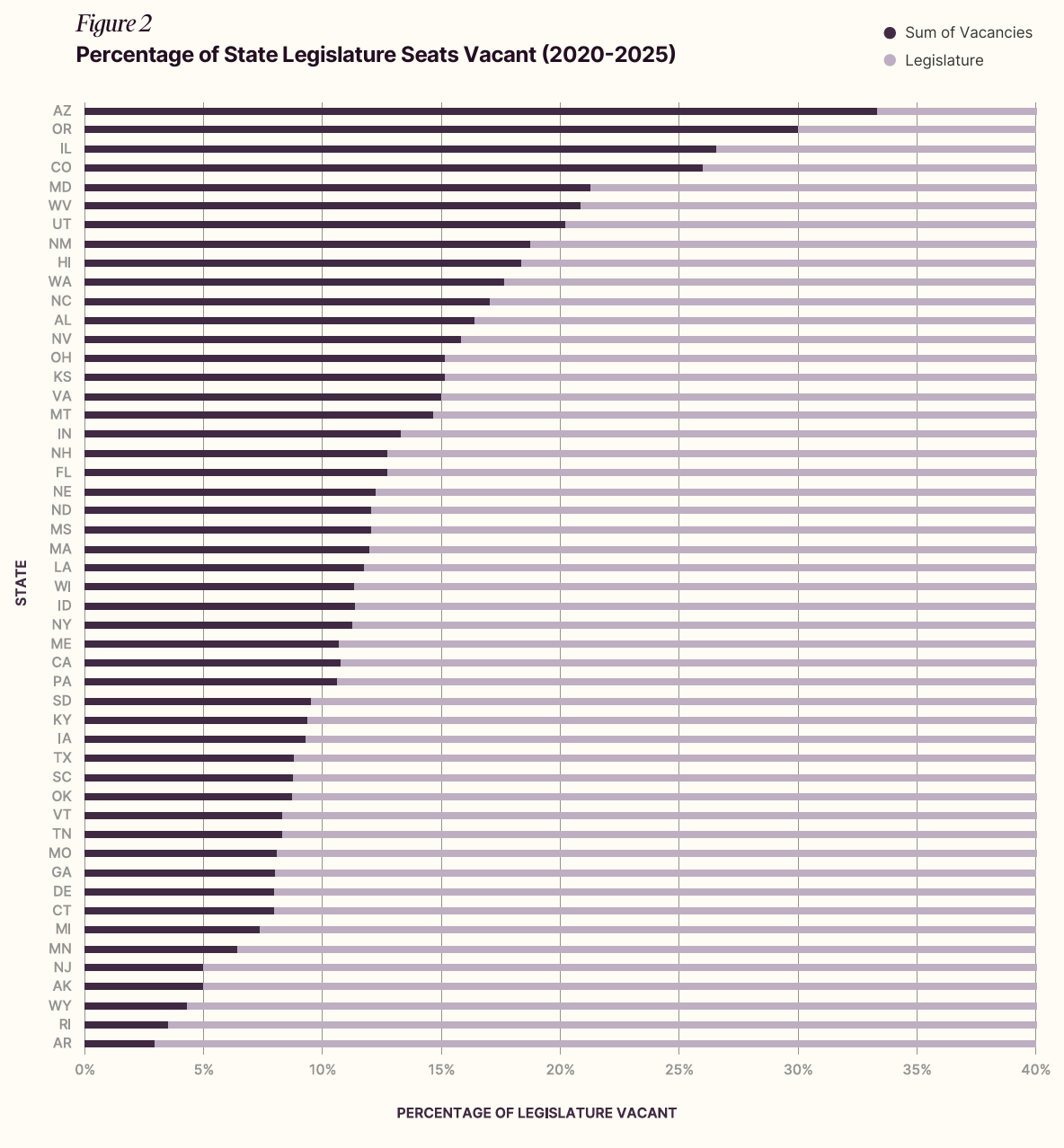
Figure 2 shows how vacancies were distributed proportionally in comparison to the total number of seats in each state’s legislative body. For example, despite having the highest number of vacancies (54) over the five year period, New Hampshire had a vacancy rate of only 12.7%. In contrast, Arizona had a lower number of vacancies (30), but the highest vacancy rate at 33.3%. The states with vacancy rates above 25% were Arizona (33.3%), Oregon (30.0%), Illinois (26.6%), and Colorado (26.0%). Conversely, the states with the lowest vacancy rates (≤5%) were Arkansas (3.0%), Rhode Island (3.5%), Wyoming (4.3%), Alaska (5.0%), and New Jersey (5.0%).
Who is Leaving Office Early?
Early Departures and Race
We looked at the demographics of legislators who left office early. In our study, the majority of unexpected vacancies, 72.7%, came from White legislators, with Nonwhite legislators accounting for the remaining 26.9% of vacancies. These rates of vacancy diverge from the proportion of White to Nonwhite state legislators in our dataset. Data from 2020-2025 shows that across all fifty state legislative bodies, the proportion of White state legislators ranged between 78-83%, whereas the proportion of Nonwhite state legislators ranged from 17-22%. Based on these data points, we found that White legislators departed office early at a slightly lower rate than their proportional representation and Nonwhite legislators departed early at a rate higher than their proportional representation.1
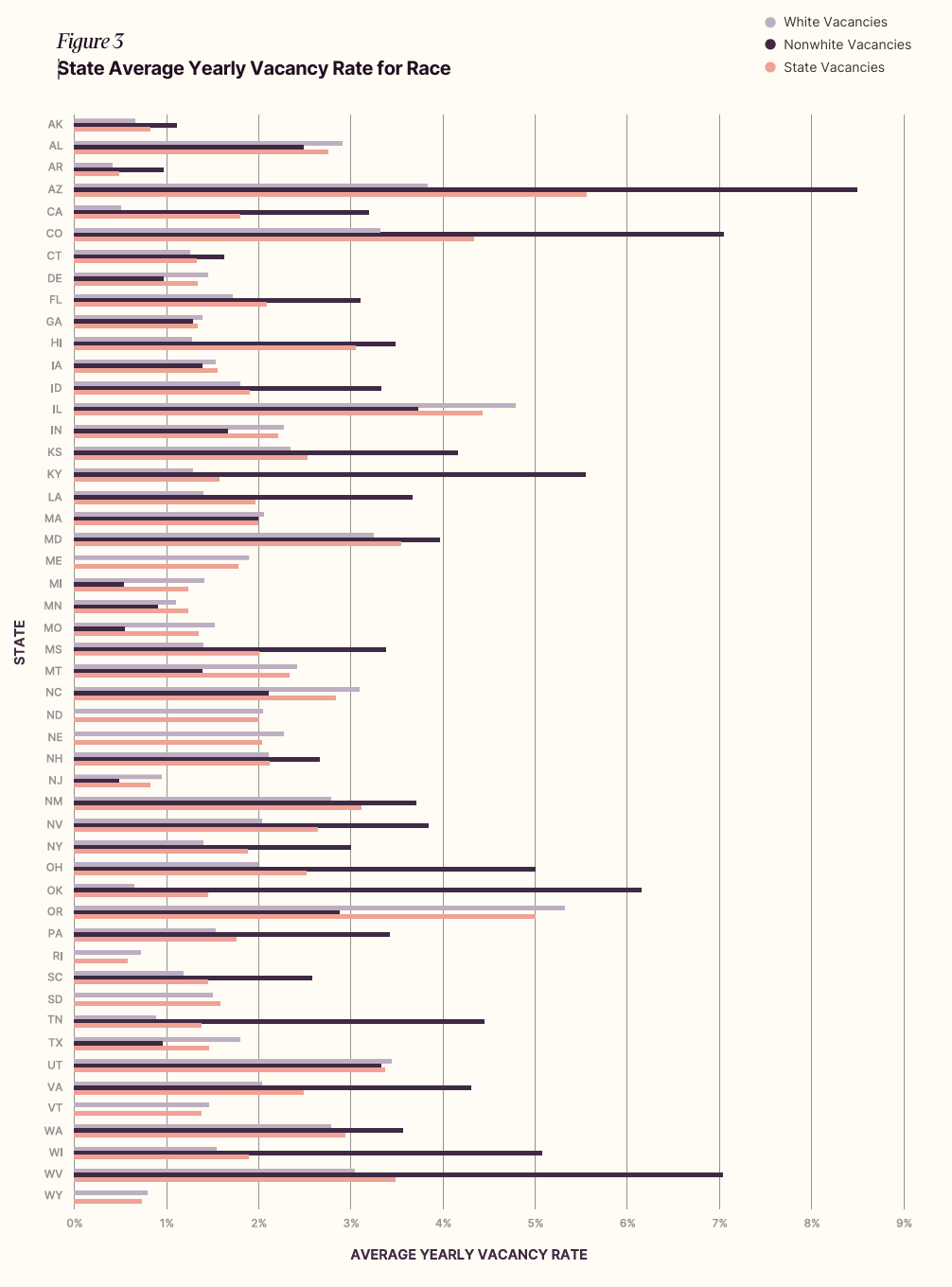
To account for a legislature’s changing demographic composition over time, we calculated an average yearly vacancy rate for each state using the vacancy rates from each year between 2020-2025. We then compared that to the average vacancy rates for each demographic subgroup across each year. Figure 3 shows how each state’s average yearly vacancy rate compares to the average vacancy rates for White and Nonwhite legislators. In 27 states, Nonwhite legislators left office at a higher rate than the average rate for the state. Oklahoma had the largest variance, where the vacancy rate of Nonwhite legislators was 4.7 points greater than the state’s average vacancy rate. The smallest difference was 0.3 points, which occurred in Alaska.
We found that in 21 states, the vacancy rate for White legislators was higher than the state’s average yearly vacancy rate in 21 states; however, the differences tended to be lower. The largest difference was in Illinois, where the rate of White legislators leaving office was 0.4 points greater than the average rate of vacancies. The smallest difference was 0.02 points in Minnesota.
Early Departure and Gender
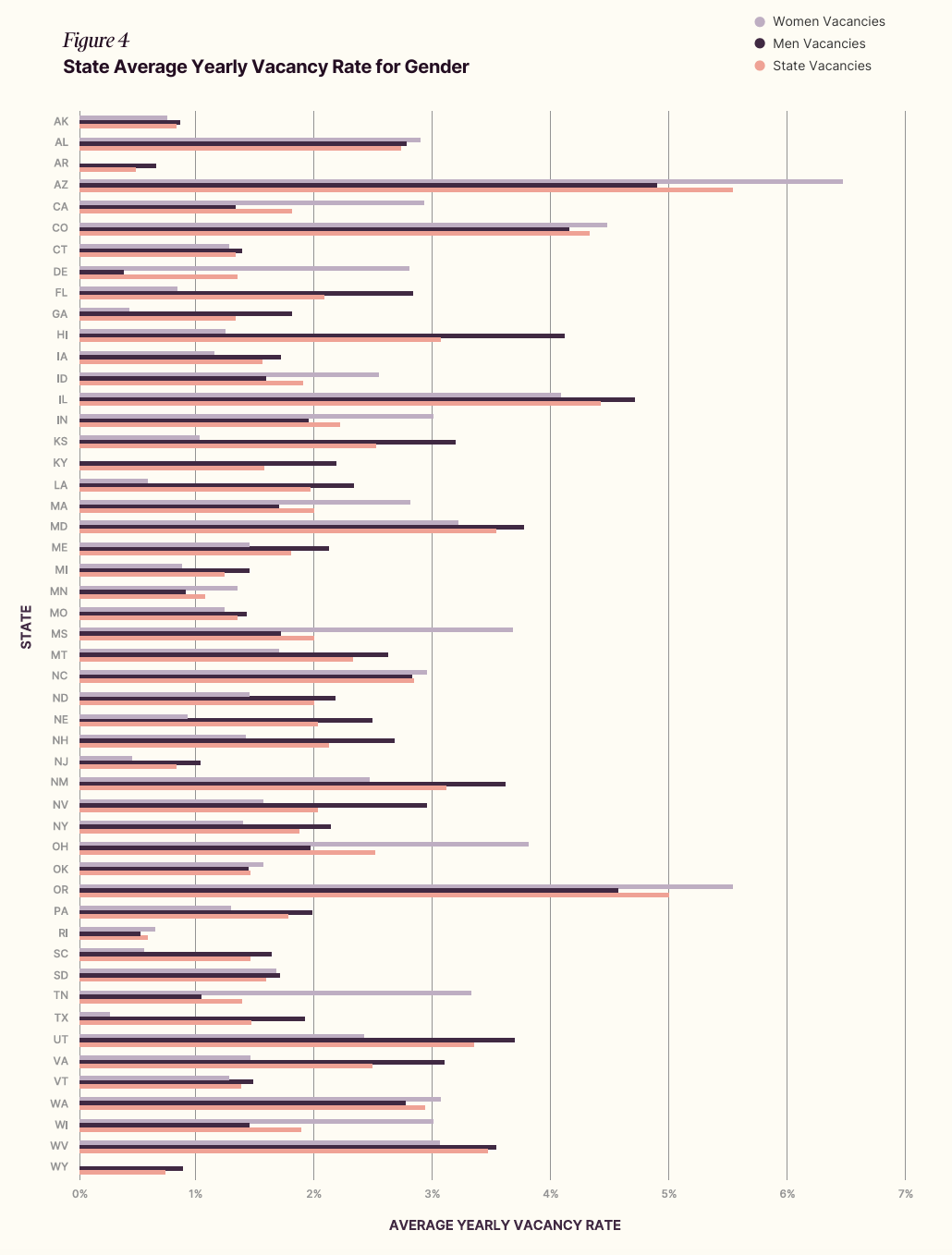
We additionally analyzed the gender breakdowns of legislators who left office early, focusing on men and women legislators2 vacancy rates to better understand where there were notable differences between these subgroups. In our analysis, we found a few noteworthy differences between early departures for men and women. Looking at the dataset as a whole, we found that the vast majority (71%) of unexpected vacancies were of men, with women making up the remaining 29% of early vacancies. This generally aligns with the gender breakdown of state legislatures averaged across states, where women make up a median average of 31.6% across all states.
To better understand vacancies as the legislatures’ compositions evolved, we again examined the average yearly vacancy rates for gender for each year between 2020-2025. Looking at each state’s average yearly vacancy rate to the average yearly vacancy rates for men and women revealed some state-by-state gaps where women outpaced the average rate, as illustrated in Figure 4. One example of this is in Mississippi, where the average yearly vacancy rate between 2020 and 2025 was 2.0%. The average vacancy rate for men was 1.7% but the average rate for women was 3.7%. In Mississippi, men left office at a rate marginally under the average while women left office 1.5 points above the average and 2 points higher than men.
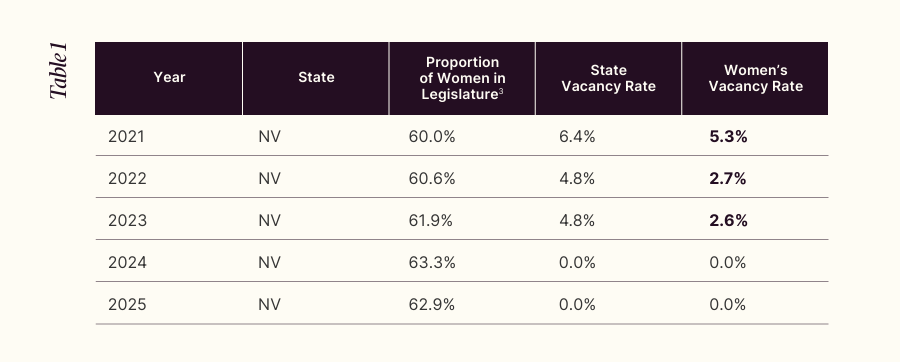
When exploring state vacancy rates year by year, some notable patterns emerge for states with some of the highest proportions of women and states with the lowest proportions of women. Year over year, women in Nevada (where the state legislature is majority women) had a slightly lower average vacancy rate compared to the average yearly vacancy rate for the state.
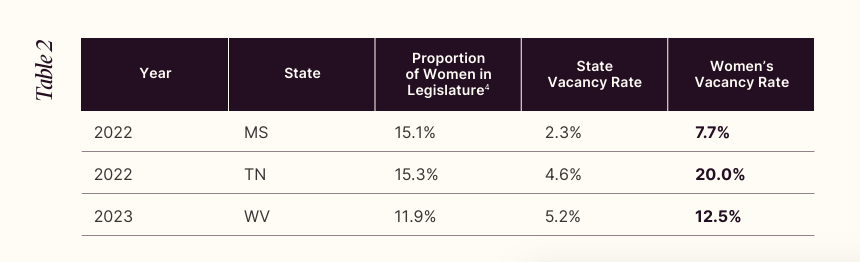
For states with lower proportions of women legislators, we identified several discrepancies in vacancy rates. Women made up 15.1% of the legislature in Mississippi in 2022, when the difference in average vacancy rates between men and women was 5.4 points.
We found that West Virginia had the lowest proportion of women legislators for five years straight. Additionally, in 2023, we also observed West Virginia having a significant difference in average vacancy rates for men and women of 8.3 points. The vacancy rate for women in West Virginia (12.5%) also exceeded their representation within the legislature (11.9%).
But perhaps most notable is Tennessee. Women made up 15.3% of the legislature in 2022, when the difference between men and women’s vacancy rates was 18.2 points. Additionally, looking at the racial breakdown of women departing office early that year, we see that 6% of Tennessee White women departed early, whereas 60% of Tennessee Black women departed early. This includes former legislators such as Katrina Robinson, who was the first-ever expulsion from the Tennessee Senate, as well as Barbara Cooper, who passed away in office and secured re-election posthumously at age 93.
Early Departures and Age
We identified the ages for 72% of legislators who left office early.
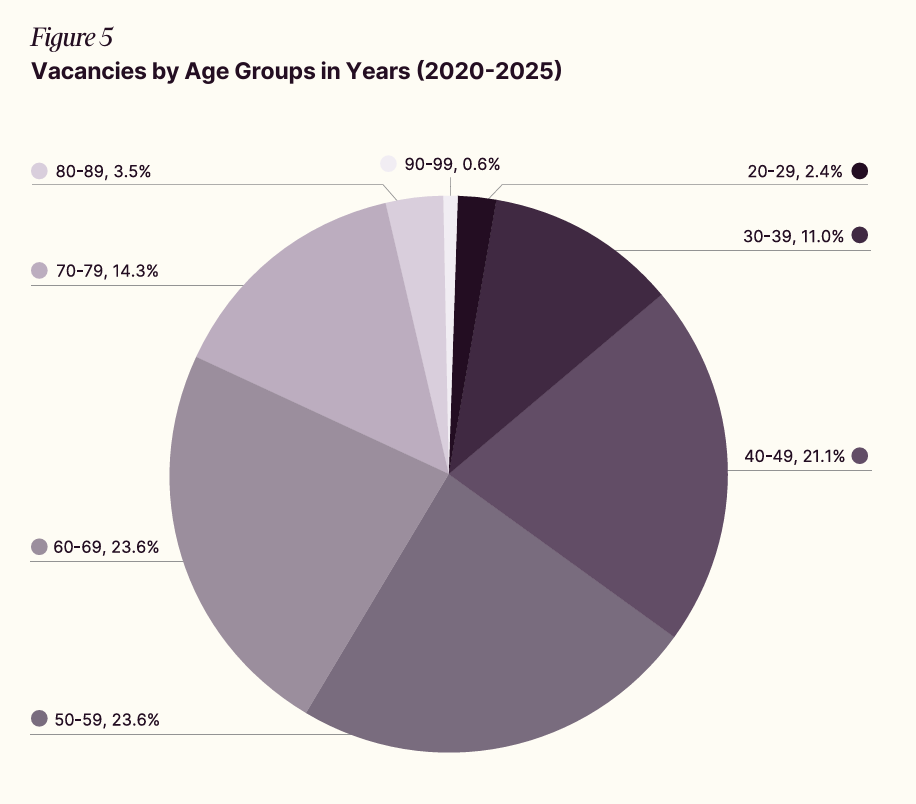
Figure 6 shows how early departures for each demographic subgroup were dispersed across each age group. Early departures for White men were highest near the average retirement age in the US of 62; whereas vacancies for White women, Nonwhite men, and Nonwhite women were highest earlier than retirement age. Specifically, we found that for Nonwhite men and women, vacancies most commonly occurred in the 40-49 age group. For White women, vacancies were most common in the 50-59 age group, while vacancies for White men were most common in the 60-69 age group.
Early Departures and Political Parties
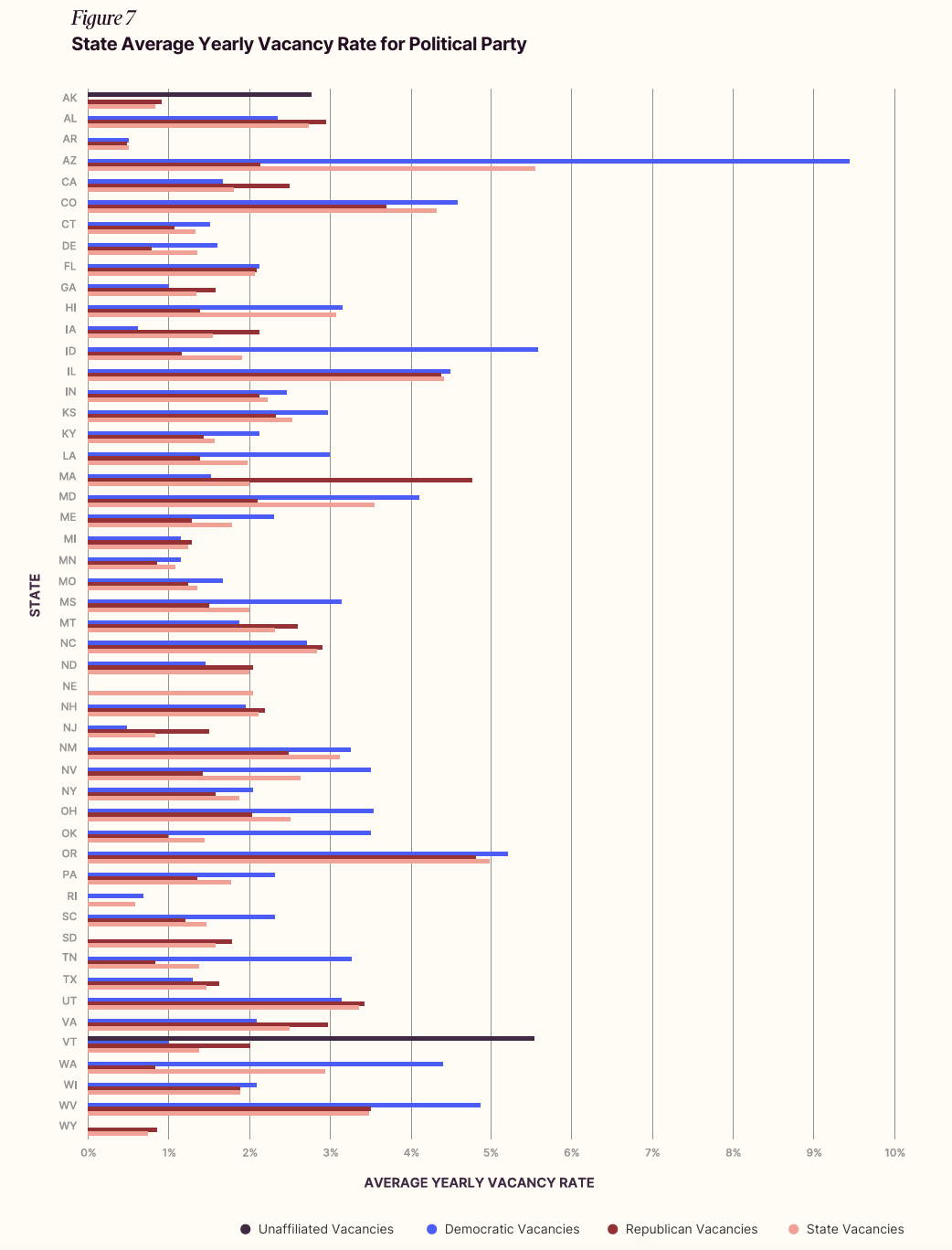
In addition to race and gender demographic data, we considered political party affiliations for state legislators who left office early. We compared the state’s average yearly vacancy rate with the average vacancy rates for political parties for each year between 2020-2025. Figure 7 shows the average yearly vacancy rate for legislators by political party compared to the state’s average yearly vacancy rate. We found that in 31 states, Democratic legislators left office at a higher rate than the average yearly rate for the legislature. Arizona had the largest difference, where the rate of Democratic legislators leaving office was 3.9 points greater than the average rate of vacancies. The smallest difference was 0.01 points in Arkansas.
Republican legislators in 20 states left office at a higher rate than their state’s average yearly vacancy rate. The largest difference was in Virginia, where the average rate of Republican legislators leaving office was 0.5 points greater than the average yearly rate of vacancies. The smallest difference was 0.01 points in Florida.
Why Are They Leaving Office Early?
To understand why state legislators leave office before the end of their term, we collected and analyzed self-reported and publicly available reasons behind their early departures. For a full overview of the categories and subcategories of reasons for early departures, as well as their definitions, please refer to Appendix 1.
We found that when legislators departed early, the reasons they cited fell into twelve main categories. The top three categories were:
- Taking on or Seeking Another Public Service Role (45.1%)
- Death or Illness (16.5%)
- Resignation for Another Job Outside of Public Service (11.3%)
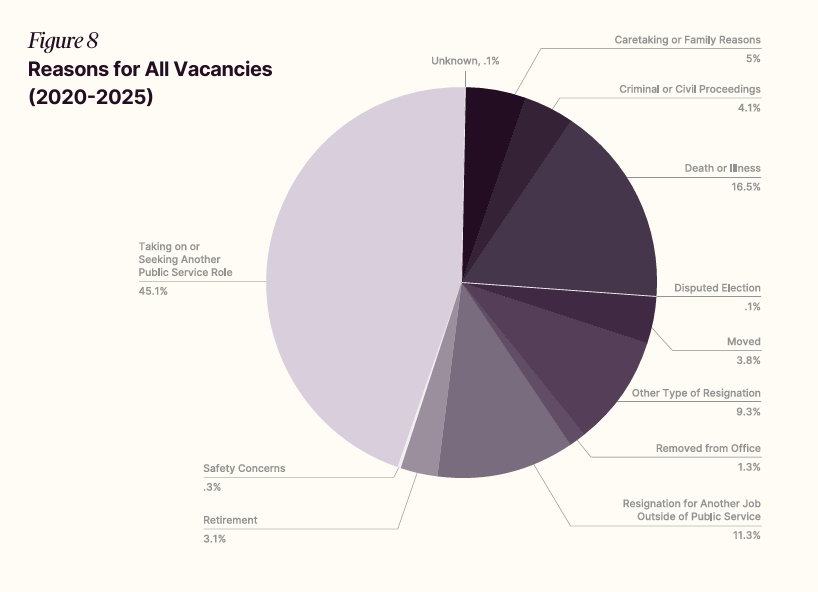
Delving deeper into these reports, our research looked at the more specific reasons legislators stated when leaving office. The precise reasons for early departures fell into twenty-one subcategories. Within these subcategories, we uncovered the top three reasons for legislative vacancies were as follows:
- Resignation for Administrative Government Position (15.4%)5
- Death (12.3%)
- Resignation for Job in Private Sector or Non-Profit (9.9%)
Resigning to pursue an administrative government position and death were consistently among the top reasons for legislators leaving office early across legislative chambers, geographic region, and gender.
We found that 10% of vacancies in each legislative chamber, and 10% of vacancies across both chambers combined, were due to lawmakers resigning for jobs in the private or non-profit sectors. Additionally, vacancies due to retirement were higher among State Senators (7.6%) than State Representatives (1.4%); however, vacancies due to death were slightly higher among State Representatives (12.7%) than State Senators (11.3%).
These findings indicate that, apart from death, state legislators most commonly left office early for a non-elected government position, or left public service entirely.
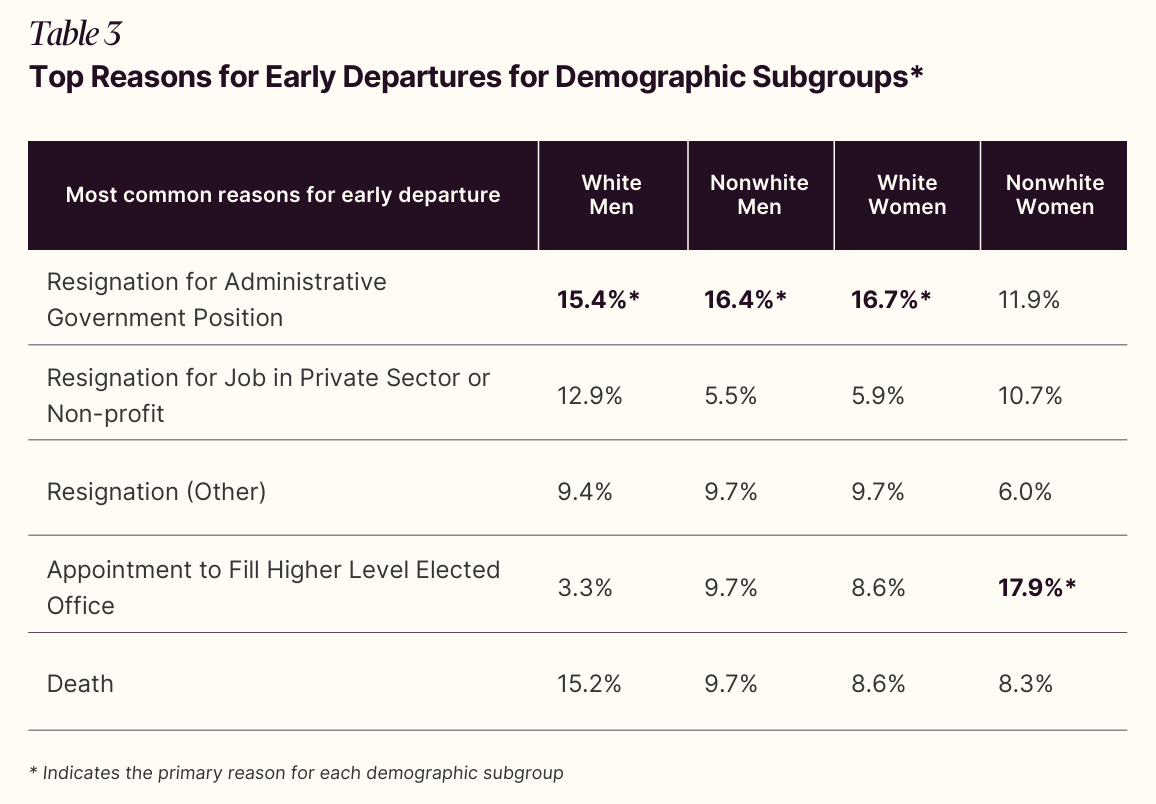
Table 3 shows the top three reasons for early departures among all demographic subgroups. Resigning to pursue an administrative government position was the most common reason for early departures among Nonwhite men, White men, and White women. Nonwhite women, however, deviated from this trend. Nonwhite women most commonly left office early due to appointments to higher level offices. This often looks like an appointment for a State Representative to fill a State Senate vacancy. In another example, Shirley Weber served in the California State Assembly before being appointed as California’s first African-American Secretary of State in 2020.
Even when state legislators serve in the same roles across states, their experiences can vary greatly. Lawmakers face divergent realities based on their unique circumstances, including age, family obligations, which state in which they serve, and the level of institutional support they receive. To better understand the context behind Oregon’s high vacancy rate, we spoke to Barbara Smith Warner, Senior Advisor at IRG. Smith Warner previously served as an Oregon State Representative from 2014-2022, including three years in which she served as the Majority House Leader. Although Smith Warner completed her term, she cited a number of personal reasons behind leaving the legislature that mirrored many of our findings. From her experience as a former state legislator, she highlighted additional state policies that may support officeholder retention. First, promoting information about legal and other support structures protecting outside employment. Additionally, the widespread ability to hire full-time staff to support legislators with juggling their legislative and personal responsibilities. Finally, encouraging strong legislative caucus structures, including but not limited to identity-based, seniority-based, and party-based caucuses. Caucus structures, in Smith Warner’s view, were instrumental in providing mentorship, onboarding, and peer support during her tenure.
Smith Warner explained that she left the legislature feeling as if it was time to move on, never desiring to be a long-serving legislator. She ended our conversation saying, “I loved that job. We did so much great policy. What makes a citizen legislature work is a mixture of people with experience and people with new ideas and fresh perspectives. You need both – you need experience and you need fresh ideas.”
To understand more, we looked deeper into the structural and environmental factors that may influence a legislator’s decision to leave office early.
Legislative Salaries
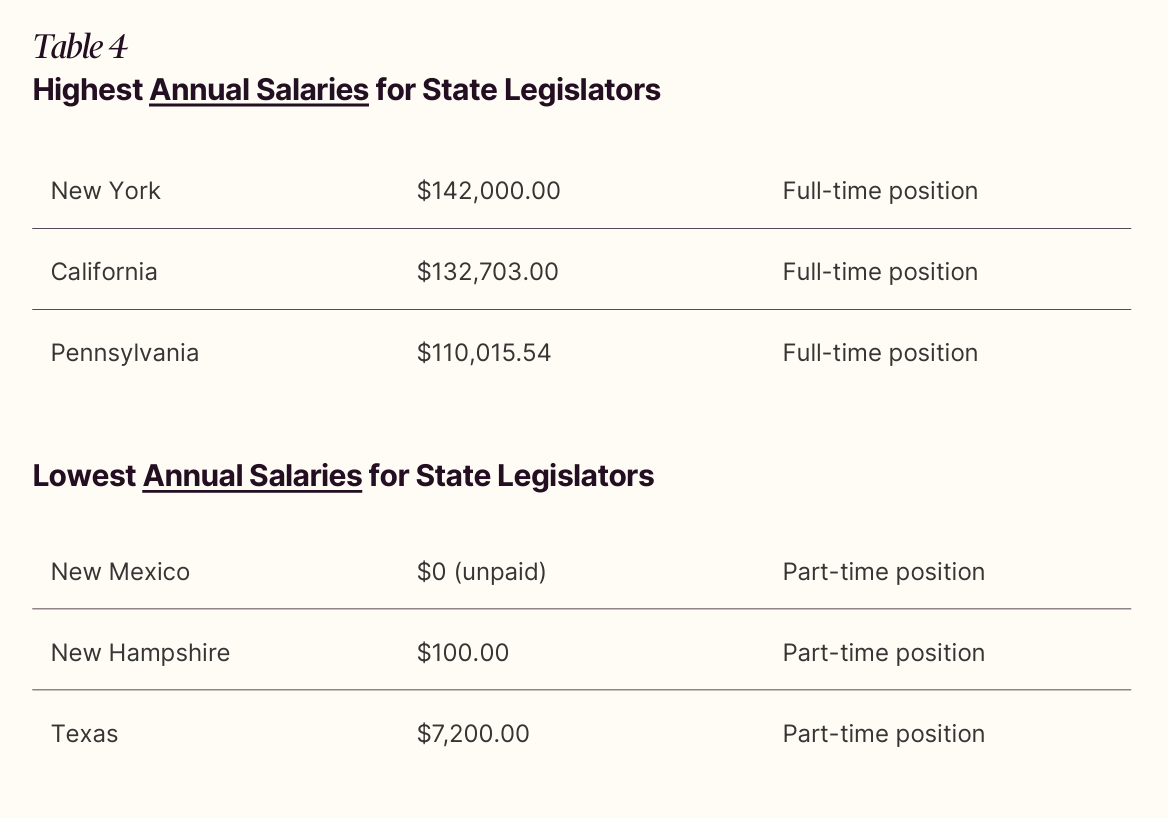
First, we analyzed salary information from the National Conference of State Legislatures to look for departure trends among the highest and lowest paid legislatures. Table 4 displays the states with the five highest and the five lowest annual state legislative salaries.
As illustrated in Figure 9, we found no strong correlation between early departures and salaries. Despite this, legislators most commonly leaving office for jobs in administrative government positions or in the private and non-profit sectors indicates that salary may have some impact. Further research into which fields and paygrades legislators entered after leaving office is needed to better understand this potential relationship. Research that includes year-by-year or demographic breakdowns may also uncover stronger correlations between the variables.

Policies on Employment Outside the Legislature
In addition to state legislator salaries, we considered state restrictions on outside employment during state legislators’ time in office. We found that all states allow legislators to have outside employment during their time in office, but all states also had restrictions. These restrictions generally prohibit conflicts-of-interest and specify what types of positions (typically civil or legal) legislators can have during their term. New York, with the country’s highest salary for state legislators, has a restriction directly limiting how much income a legislator can earn outside of the legislature. Minnesota pays its state legislators a salary of $51,750 and requires that they take leaves of absence from outside employment during legislative sessions. Legislators in Minnesota can only have outside employment when the legislature is not in session; however, employers are required to re-hire legislators who re-apply for their positions within a month of the legislative session ending. Other restrictions are indirectly applied, instead granting powers to the legislator’s outside employer. North Dakota, which pays its part-time legislators a monthly rate of $592, allows legislators to maintain outside employment while in office, but their employers decide whether to grant leaves of absence. The employer also decides whether the leave of absence will be paid or unpaid.
The three highest-paying states – New York, California, and Pennsylvania – have full-time legislative positions. Conversely, the states with the lowest salaries – New Mexico, New Hampshire, and Texas – have part-time positions. Despite this variation in structure across states, we found no strong correlation between early departure and states with full-time versus part-time structured state legislative terms.
Early Departures for Caretaking and Family
Finally, we looked deeper into vacancies where the legislator left due to caretaking or other family reasons. These vacancies were found in 27 states, and made up 5.0% of early departures. We suspect that caretaking and family reasons are cited less often as reasons for leaving office given the more personal and sensitive nature of this information, possibly making it an underreported reason. It’s all the more important that we listen when legislators share these experiences so that we can better support them during their time in office.
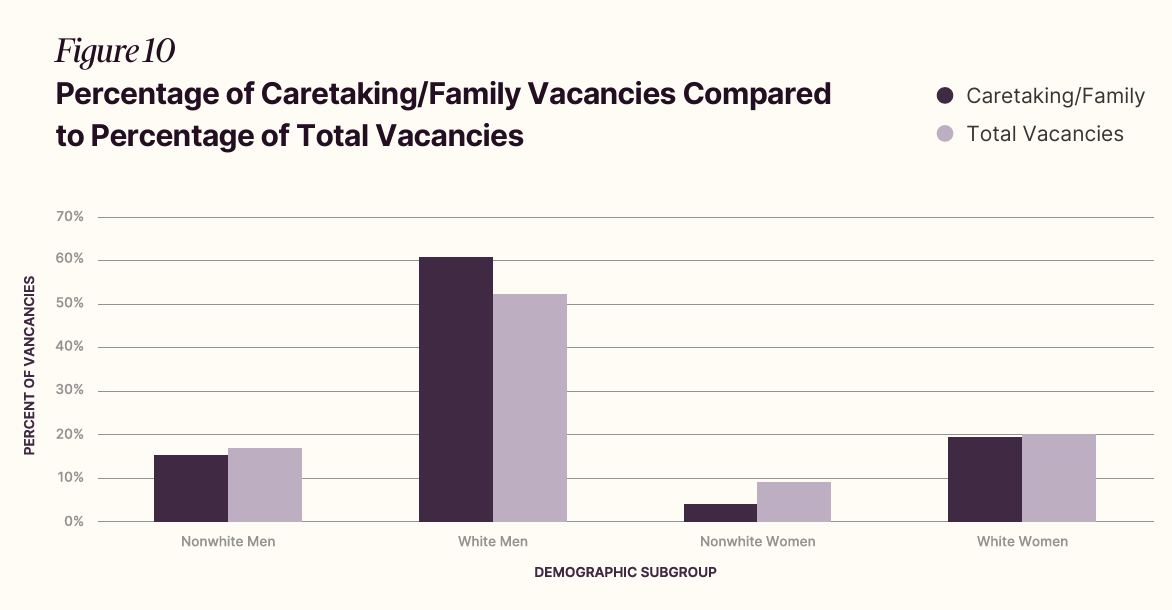
In Figure 10, we see that White men reported caretaking or family reasons when resigning at rates higher than their proportional representation across all fifty legislative bodies. White men made up 52.6% of all vacancies, but they constituted 60.9% of early departures due to caretaking or family reasons. White women reported these reasons at nearly the same rate as their proportional representation (19.6% and 20.1%, respectively). However, Nonwhite legislators reported these reasons at lower rates than White legislators. Nonwhite women made up 9.1% of all vacancies, but reported caretaking or family reasons when resigning for only 4.3% of their respective vacancies. This suggests that Nonwhite women are much less likely to claim these personal needs when resigning.
Further examination into caretaking-related vacancies showed that caretaking for a child accounted for the majority of these early legislative departures at 61.1%. Caretaking for multiple family members was the least common subgroup of caretaking vacancies, representing 5.6% of these early departures.
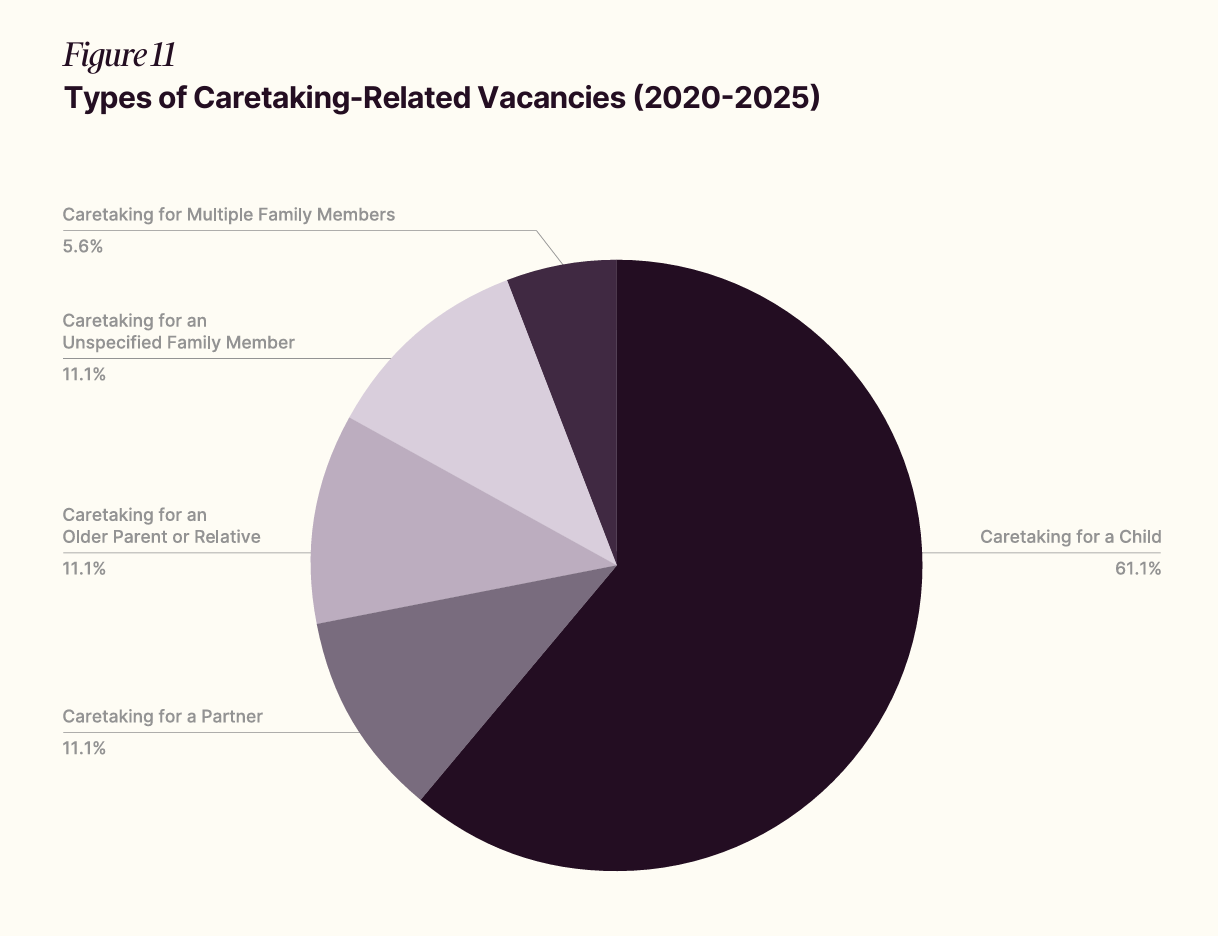
Due to caretaking and family reasons being cited less commonly as reasons for early departures among state legislators, we don’t have enough data to ascertain whether these reasons for early departure are more prominent among certain age groups.
The challenge of balancing caretaking and family needs on top of legislative duties without support can weigh heavily on legislators throughout the country. For example, Idaho State Senator Steve Bair resigned to provide care for his wife and their older son, who was diagnosed with a terminal illness. In his 2021 resignation letter, Senator Bair wrote, “Simply stated, we cannot find a way to balance our family’s needs with continued service in the Legislature for the upcoming legislative session.”
More recently in 2025, Colorado General Assembly Minority Leader Rose Pugliese resigned before the end of her elected term. Pugliese, a single mom from Colorado Springs, addressed her constituents in her resignation letter and stated that her kids “have made so many sacrifices for me to be able to represent you. But they also need their mom right now, and I need to keep them safe.” She cited the contentious end to the legislative session and recent acts of political violence as additional reasons for her departure.
State Delegate Rachel P. Muñoz accounts for one of the vacancies from the Maryland legislature. Muñoz resigned in January 2025, stating that she wanted to spend more time with her young family. When questioned about whether her absences contributed to her decision to leave the legislature, Muñoz revealed that she was pregnant with her sixth child and had been facing a series of health challenges. One of Muñoz’s Republican colleagues later categorized her decision to resign as strategic, saying, “If she missed that much time again for another year, she wouldn’t win reelection.”
The anonymous quote given by one of Muñoz’s colleagues regarding her absence in the 2024 legislative session encapsulates the challenges faced by young lawmakers. There are no onsite childcare programs or any specific childcare benefits provided for lawmakers in Maryland. According to the Vote Mama Foundation, Maryland allows for the use of campaign funds to cover childcare expenses; however, lawmakers cannot use campaign funds to cover childcare expenses incurred while performing official duties.
Early Departures for Safety Concerns
Legislators like Pugliese face a heightened threat environment that leads many to question whether public service outweighs the risk to themselves and their families. Elevated levels of political violence, including threats, targeted harassment, and physical attacks, have shaken the psyche of legislators at every level of government. According to a survey conducted in 2024 by the Brennan Center for Justice, 43% of state legislators reported receiving threats, with a further 29% indicating that the gravity or “seriousness” of the threats against them had increased in recent years. The heightened threat environment puts a unique toll on those balancing family life with high-profile legislative roles, with some opting to leave government work altogether. Moreover, a recent string of politically-motivated assassinations heightens fears of lawmakers with young families who must weigh their career prospects against threats of real harm. Despite these reports, we found that safety concerns were cited as the reason for 0.3% of early departures. Similarly to caretaking and family-related reasons, legislators may not cite this reason as often due to its sensitive and personal nature.
How are These Vacancies Filled?
While a similar number of Democrats and Republicans left office early between 2020 and 2025, there were more Democratic replacement officeholders (54%) than Republican (44%). Additionally, women made up 29% of the legislative vacancies but 39% of the replacement officeholders. We also found that Nonwhite legislators made up 27% of the vacancies but 31% of the replacement officeholders; however, this should take into account that the number of Nonwhite officeholders (249) and replacements (258) were roughly similar.
Through our research, we found that filling mechanisms for vacancies broadly fell within four categories:6
- Appointment (e.g. by Governor, or by State or County Political Party) (46.4%)
- Special Election (30.0%)
- Seat to Remain Vacant Until Next Regular Election (20.6%)
- Interim Appointment, followed by a Special Election (2.5%)
The least common method of filling a vacancy was an interim appointment followed by a special election, whereas appointment was the most common. Figure 12 displays a state-by-state breakdown of which filling mechanisms were used. The graph also shows where states used a single filling mechanism for all vacancies. For example, we found that Hawaii only filled legislative vacancies through appointments during this period.
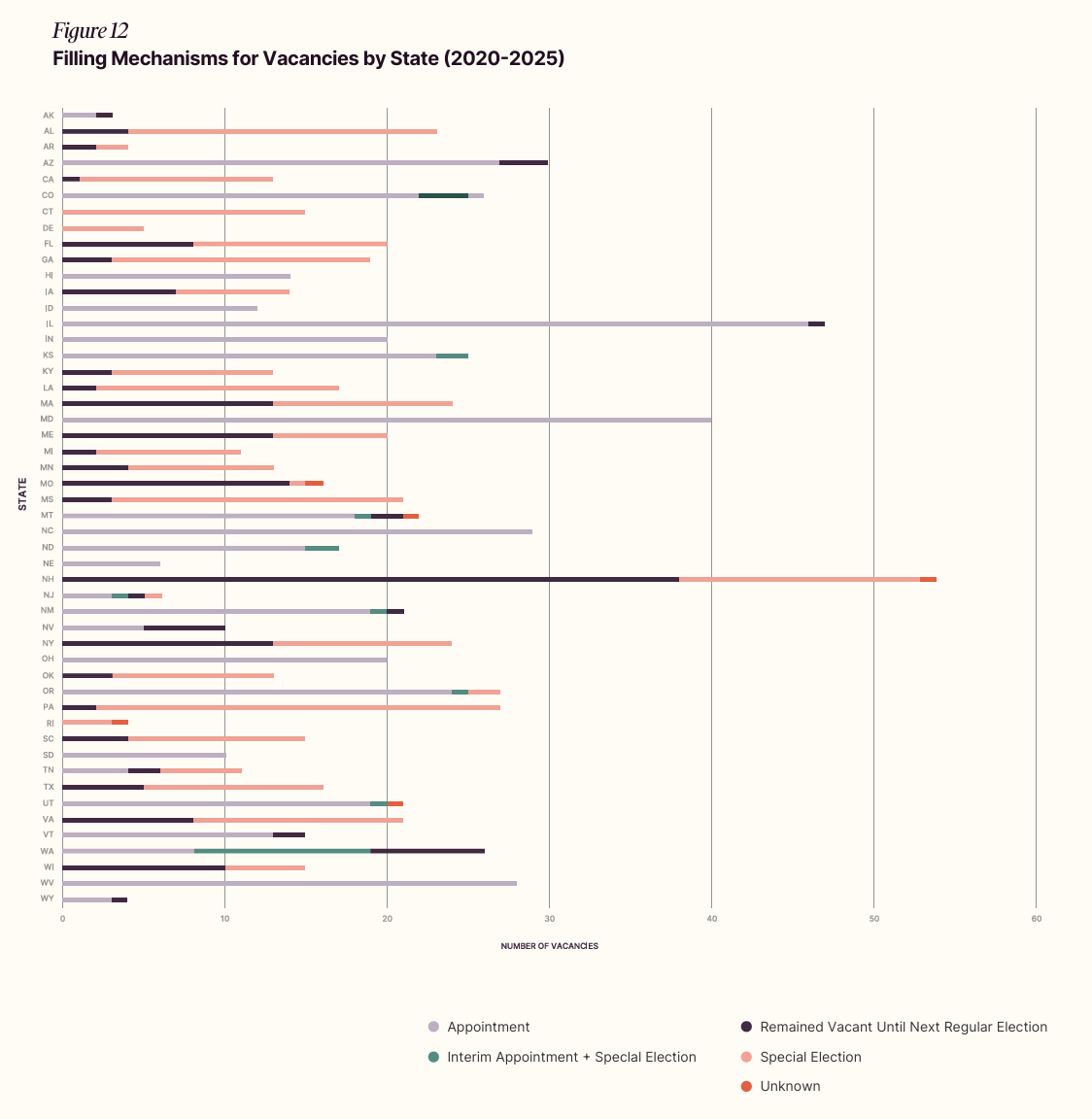
Offices in New Hampshire, the state with the highest number of vacancies, most often stayed vacant until the next regular election. In Illinois, the state with the second highest number of vacancies, the most popular filling method was appointment. This may be due to the fact that Illinois does not have special elections, instead filling seats via appointment for terms as short as one week. Appointment was also the most common filling mechanism in Maryland, the state with the third highest number of vacancies.
As illustrated in Figure 13, we studied whether the filling mechanism affected the length of a vacancy.
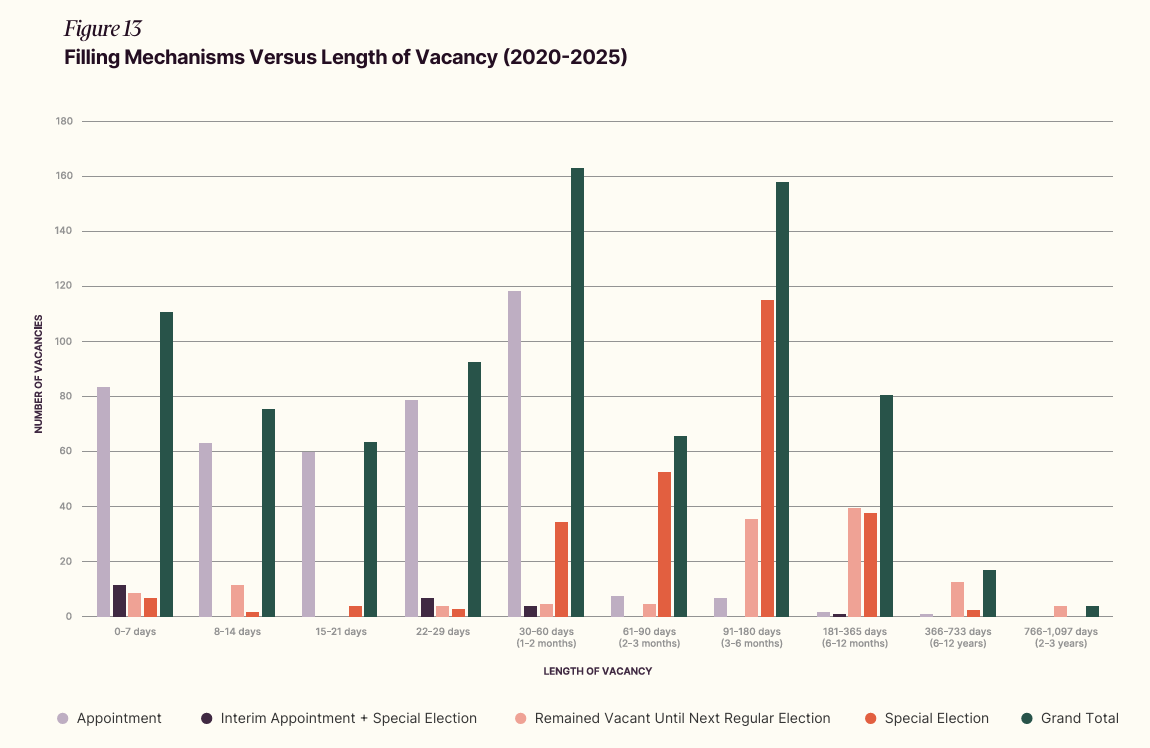
On average, vacant offices were filled in 85.4 days. Many of the 0-7 day vacancies were explained by appointments that occurred before the vacancy actually took effect, so that the new officeholder took office immediately and the office never sat vacant. On average, offices filled by appointment were filled in 29.2 days. Those filled by an interim appointment, followed by a special election were filled in an average of 23.7 days. Vacancies filled by interim appointments were almost always filled within the first month of the vacancy, although the special election occurred at a later point. When a seat was left empty until the next regularly scheduled election, it stayed vacant for an average of 181.4 days; however, four outliers that appear to have been vacant for 2-3 years skew the average to 205.4 days. Vacancies filled by a Special Election were filled in an average of 123.9 days.
How and when vacancies get filled can have large impacts on the experience of constituents. Additionally, having a vacant seat in the legislature has large implications for state-level advocacy. For example, in states like Illinois, where appointments were the main filling mechanism, the officeholders serving these districts were not chosen by the voters. In states like New Hampshire, where vacancies were primarily kept open until the next regular election, constituents were often unrepresented at any given time. Representation for constituents lessens the longer an office stays vacant.
Resources to Support State Legislators
State legislators need to feel safe and supported during their public service to better represent their constituents. Whether support comes from the state or through a third party, having access to further support could be the difference between a legislator completing their term and a voter not having representation.
An important starting point is physical safety, at government buildings and especially at home. States can directly support legislators by establishing security and safety measures. Currently, just five states protect legislators’ safety by not including home addresses when someone makes a public records request. States like California, Colorado, Louisiana, Minnesota, and Wisconsin have laws explicitly allowing the use of campaign funds on security expenses. Other states indirectly allow the use by listing “security” as an approved expense. The increase in threats pushed some legislative bodies to introduce new security measures, with states like Michigan voting to beef up security for members and their families.
Additionally, some states established protections for outside employment. While we found no strong correlation between early departures and salaries, boosting legislators’ income during their time in office is likely a welcome method of support during their time in office. These protections mostly focused on a legislator’s ability to take a leave of absence while in office. These states include Kansas, Minnesota, Nevada, and Oregon. In North Dakota, a legislator granted leave cannot be terminated solely because of their legislative service. Two states, Connecticut and Nevada, have direct protections for legislators working during their time in office. Connecticut prohibits employers from removing seniority status, limiting available shifts, or discriminating against a legislator who misses work to perform their duties. Employers who provide pension plans in Nevada cannot treat time acting as a legislator as a break in employment affecting the pension.
Conclusion
Healthy turnover is what gives a legislature its ability to change with the times while still retaining institutional knowledge. An effective government that builds trust and engages with the public needs legislators that feel supported in performing their civic duties through the end of their terms. But we see state legislators across the country leaving office before the end of their term, leaving voters unrepresented. They face increasingly insurmountable challenges that force many to reconsider their future in public office. States with policies and resources that support lawmakers in carrying out their civic duties are taking the first step toward addressing this issue.
Future Research
Further investigation is needed to explore the following questions:
- What is the impact of vacancies on constituents residing in the vacated legislative district? How do state legislative vacancies affect service delivery to constituents?
- Are some districts more likely to be left unrepresented for longer periods, and does that correlate with certain demographics (e.g. race, rural / urban districts, income levels, etc.)?
- Are there mitigating structures or policies that may explain differences in retention of officeholders, or affect the rate of early departures? For example, we identified potentially interesting outliers in the following states that may have mitigating patterns due to their unique policies.
- New Mexico having no pay for state legislators but permitting usage of campaign funds for security
- Illinois having no special elections for vacancies
- What legislative work (e.g. committees) is left behind by state legislators who leave their term early? What bills did they introduce but couldn’t make progress on due to leaving early?
- What positions are state legislators departing early for (e.g. lobbying, other elected office, private sector, etc.)? How does that industry or role’s compensation compare to the state legislative compensation? What is the industry breakdown of jobs held by state legislators (using financial disclosure forms)?
- What salary brackets are state legislators leaving their public service role for?
1. See Appendix 2 in the downloadable report for the demographic breakdown of state legislators as a whole from 2020-2025.
2. Other gender identities in our demographic dataset comprise less than 1% of our dataset and thus were not included in our analysis.
3. Sourced from CTCL’s Governance Project dataset snapshots.
4. Sourced from CTCL’s Governance Project dataset snapshots.
5. Administrative Government Positions are non-elected and non-legislative roles. Examples of these positions include roles in the Governor’s office, a state department, or a federal agency.
6. See Appendix 1 in the downloadable report for definitions for each filling mechanism.